
NPC deputy from Sichuan breathes new life into TCM with sci-tech innovation
Geng Funeng, chairman of Sichuan Good Doctor Panxi Pharmaceutical Co in Xichang city, Southwest China's Sichuan province, has dedicated himself to the innovative development of traditional Chinese medicine (TCM).
Geng, also a deputy to the National People's Congress (NPC), has been a vocal advocate for the globalization and modernization of TCM.
At the annual NPC sessions, he has submitted over 40 suggestions, focusing on issues such as aligning Chinese patent medicine clinical trials with international standards, accelerating the development of ethnic medicines and promoting the global outreach of TCM.
These suggestions have received significant attention from relevant government departments, Geng said with satisfaction
Having grown up in an environment that was steeped in TCM, Geng seized the opportunities arising from China's reform and opening-up and established a medicinal herb trading business in 1986. This venture laid the foundations for what would eventually become the Good Doctor brand, a name that resonates with the company's mission and values.
"Good Doctor is more than a name; it's a commitment," Geng declared.
Under his leadership, the company has evolved into a major enterprise integrating scientific research, production and trade — ranking among China's top 100 pharmaceutical companies for 14 consecutive years.
"Our mission is to bring the benefits of TCM to the world," Geng said, adding that the goal must be underpinned by scientific innovation.
"We need to clearly articulate the efficacy of TCM using modern scientific language and tools," he said.
Over the years, Geng has spearheaded the establishment of multiple research platforms, investing significantly in the development of new and original pharmaceuticals, which led to 13 innovative drug projects and 12 generic drug projects. In collaboration with renowned universities, his company has conducted over 100 research and development projects at national and provincial levels.
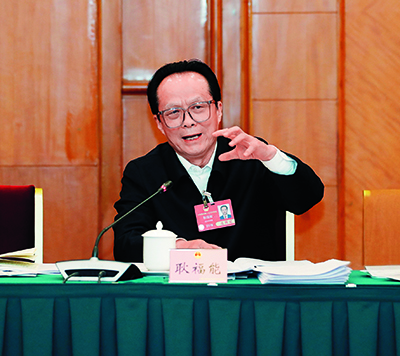
Geng Funeng, chairman of Sichuan Good Doctor Panxi Pharmaceutical Co in Xichang city, Southwest China's Sichuan province, and a deputy to the National People's Congress (NPC), speaks at a group meeting during the annual NPC session in March 2025. [Photo provided to npc.gov.cn]
Geng was elected an NPC deputy in 2013. Since then, he has conducted over 80 surveys focusing on poverty alleviation through promoting TCM-related business, innovation in medical science and technology, training of rural doctors, intellectual property protection and comprehensive rural vitalization.
What's more, he has submitted more than 130 suggestions to the annual NPC sessions and produced over 230,000 words of documents — diligently fulfilling his commitment to serving the people with utmost dedication.
"I am a grassroots deputy from Liangshan Yi autonomous prefecture," he often says, with a deep emotional connection with his hometown.
Since 1996, he has led efforts to alleviate poverty through the cultivation of medicinal herbs in his hometown, employing a "company + Party branch + cooperative + base + farmer" model.
Currently, his company has achieved large-scale cultivation of over 65,000 mu (4,333 hectares) of medicinal herbs in the prefecture and in various regions across the country — improving the incomes of over 147,000 farmers.
Beyond his business endeavors, Geng has made substantial contributions to the education and healthcare sectors through philanthropic initiatives. He has established scholarships at 11 universities, supporting educational and sports development as part of the company's community outreach efforts.
"In nearly 40 years of business development, the core philosophy of 'being a good person, making good medicine' has been my guiding principle," Geng said.
"The company doesn't belong to any individual; it belongs to society. Such social responsibility is rooted in the genes of the Good Doctor," he added.
Geng said that he will remain committed to leading his group in enhancing its sci-tech innovation and promoting the global outreach of TCM.