
Ningxia deputy is dedicated to promoting global outreach of Chinese culture
In the vibrant tapestry of global cultural exchanges, Zhang Shirong, chairman of Wisdom House International Culture Communication Group based in Yinchuan, capital of Northwest China's Ningxia Hui autonomous region, is something of a mover and a shaker.
He is playing a prominent role in weaving Chinese culture into the very fabric of the world through the country's Belt and Road Initiative (BRI).
"My original intention was to be a communicator of Chinese stories — enabling Chinese culture to go global and be integrated into Belt and Road countries," said Zhang, who is also a deputy to the 14th National People's Congress (NPC), underscoring his commitment to fostering cross-cultural understanding.
Driven by a passion for cultural exchanges, Zhang embarked on his journey in 2011, when he quit his university teaching position and ventured into cultural entrepreneurship.
The country's launch of the BRI in 2013 marked a turning point, offering Zhang and his team new horizons and opportunities. He got himself a clearer goal: To tell China's stories and share Chinese culture with the world.
Under his leadership, Wisdom House has translated and published books in over 10 languages, including Arabic and Persian, selling nearly 2 million copies.
In addition, they have translated, published and distributed over 70 themed series of books such as Understanding China — alongside more than 330 Chinese films and animations.
"The success of the blockbuster animated film Ne Zha 2 shows that quality creations will always find an audience," Zhang said. "With our profound civilization as a foundation, we can continuously produce cultural products with distinctive Chinese style that resonate globally," he added.
In August, Liu Gu Er, a film funded by Wisdom House, premiered in Hongbao village of Zhongwei city, Ningxia. The film tells the story of villagers forming a choir to broaden their cultural and intellectual horizons.
An Arabic version of the film will soon be promoted in countries involved in the BRI, showcasing the vibrant and modern rural life in China.
But Zhang's vision extends far beyond films. His company has been active in exporting dramas, short video series, animations and online games. "Good cultural products don't mean to pander. As long as they genuinely portray Chinese stories, they will resonate with international audiences," he said.
In the realm of education, Zhang has spearheaded the establishment of Chinese language institutes in several Arab states, including Saudi Arabia and Qatar.
The Chinese language textbook developed by his team for Arab countries is the world's first set of foreign textbooks certified by the Saudi Ministry of Education and has been widely used in primary, secondary and tertiary schools as well as educational institutions in Arab countries.
As an NPC deputy, Zhang focuses on cultural development and promoting global outreach of Chinese culture. He has actively proposed suggestions on enhancing international communication and promoting Chinese language education in Belt and Road countries.
What's more, he hopes to leverage the momentum of the BRI to establish market-driven mechanisms that ensure a sustainable international presence for Chinese cultural products.
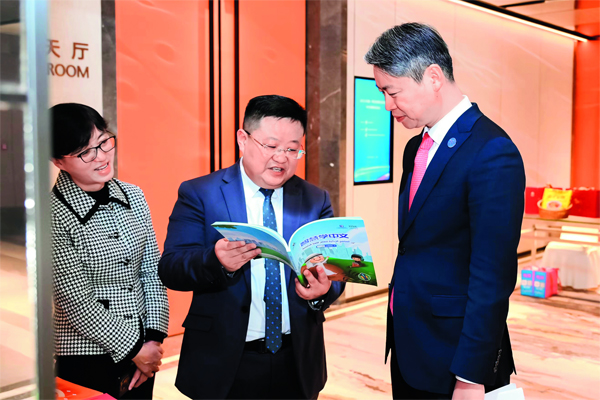
Zhang Shirong (center), chairman of Wisdom House International Culture Communication Group in Yinchuan, capital of Northwest China's Ningxia Hui autonomous region, and a deputy to the National People's Congress, presents a Chinese language textbook produced by his company. [Photo provided to npc.gov.cn]
At this year's NPC session in March, Zhang called for the introduction of policies to encourage the globalization of cultural industries. He suggested creating platforms for international exchanges to support cultural trade enterprises in adapting their products to diverse cultural contexts and consumer habits.
"We must ensure that Chinese culture not only reaches out to international audiences, but also has a lasting impact," he said.
Noting that the non-public sector still has enormous potential to be unleashed in areas such as cultural communication, technological innovation and international cooperation, Zhang said that as Belt and Road cooperation deepens, Arab countries are showing a growing interest in Chinese culture.
"Private cultural enterprises, with their flexibility and innovative capabilities, can play a greater role in multilingual communication and the export of digital cultural products," Zhang said.